
Few Mediterranean cities experienced as many cultural transformations as Palermo. During its Arab golden age, this Sicilian capital housed over 300,000 inhabitants, making it one of Europe’s largest urban centers when London remained a modest settlement. This strategic crossroads absorbed Phoenician traders, Greek colonizers, Roman conquerors, Arab emirs, Norman kings, and Spanish viceroys, each leaving architectural and cultural imprints that define modern Sicily. Understanding these layers transforms casual sightseeing into meaningful cultural exploration.
Table of Contents
- Introduction To Palermo’s Historical Significance
- Prehistoric Roots And Phoenician Foundations
- Greek Influence And The Punic Wars
- Arab Conquest And Palermo’s Golden Age
- Norman Conquest And Cultural Synthesis
- Medieval Political Turmoil And The Sicilian Vespers
- Modern History: Unification To World War II
- Architectural Legacy And Cultural Impact
- Explore Palermo’s History With Expert Travel Insights
Key takeaways
| Point | Details |
|---|---|
| Strategic location | Palermo’s Mediterranean harbor position attracted successive civilizations for over 2,800 years. |
| Arab golden age | Arab rule beginning 831 CE transformed Palermo into a thriving multicultural capital with advanced irrigation and architecture. |
| Norman synthesis | Norman conquest in 1072 created unique Arab-Norman architecture blending Islamic, Byzantine, and European styles. |
| Political upheaval | The 1282 Sicilian Vespers uprising expelled French rulers and reshaped Mediterranean power dynamics. |
| Modern challenges | Italian unification in 1860 and WWII bombings tested Palermo’s resilience through destruction and reconstruction. |
Introduction to Palermo’s historical significance
Palermo occupies a critical position on Sicily’s northern coast, where the Tyrrhenian Sea meets ancient trade routes connecting Europe, Africa, and the Near East. This geographic advantage made the city a prize for maritime powers seeking Mediterranean control. Successive conquests layered cultural influences that created an identity distinct from mainland Italian cities.
Key factors in Palermo’s development include:
- Natural harbor formed by the convergence of two rivers
- Fertile coastal plain supporting agriculture and settlement
- Midpoint location between Carthage, Rome, and Greek colonies
- Protected position beneath Monte Pellegrino
Each civilization adapted Palermo’s urban fabric to serve commercial, military, or administrative needs. Phoenician merchants established trading posts. Greeks built temples and theaters. Arabs introduced sophisticated irrigation. Normans constructed palaces fusing Eastern and Western aesthetics. These contributions created architectural palimpsests where mosques became churches and Roman forums transformed into medieval markets.
The city’s role extended beyond Sicily, influencing broader Mediterranean politics and culture. Understanding why Palermo gained international fame requires examining how geography, commerce, and successive rulers interacted across millennia. This foundation clarifies how a relatively small island city achieved outsize historical importance.
Prehistoric roots and Phoenician foundations
Human activity near Palermo dates to the Upper Paleolithic period, evidenced by cave art and tools discovered at Addaura on Monte Pellegrino’s slopes. These prehistoric inhabitants exploited the area’s natural resources, including freshwater springs and coastal fishing grounds. The caves reveal early Mediterranean societies adapting to Sicily’s climate and geography.
Phoenician traders founded Palermo around 734 BCE as Ziz, meaning flower in their language. This merchant colony served Carthaginian expansion into the western Mediterranean, competing with Greek settlements spreading across southern Italy and eastern Sicily. The Phoenicians chose this site for specific advantages:
- Deep natural harbor protected from storms
- Access to agricultural hinterland
- Defensive elevation from Monte Pellegrino
- Strategic position for North Africa trade routes
Archaeological evidence shows Ziz functioned primarily as a trading hub rather than a military stronghold. Phoenician urban planning emphasized port facilities and warehouses over defensive walls. Merchants traded Sicilian grain, timber, and minerals for manufactured goods from Carthage and the Levant.
| Feature | Phoenician Period | Modern Significance |
|---|---|---|
| Harbor system | Natural dual-river port | Remains Palermo’s commercial center |
| Urban layout | Grid pattern near waterfront | Influenced medieval street planning |
| Trade goods | Grain, timber, purple dye | Established Sicily’s agricultural economy |
| Religious sites | Temples to Phoenician deities | Later converted to Roman and Christian use |
Pro Tip: Visit the archaeological sites across Sicily to see artifacts from Palermo’s Phoenician era, including pottery and inscriptions that reveal ancient trade networks.
The Phoenician foundation established patterns that persisted through subsequent eras. Commercial orientation, maritime focus, and multicultural population became defining characteristics even as political control shifted between Mediterranean powers.
Greek influence and the Punic wars
Greek colonizers arriving from Corinth and other city states renamed Palermo Panormos, meaning all port, reflecting the natural harbor formed by two rivers. This descriptive name acknowledged the geographical feature that made the site valuable. Greeks established colonies across eastern Sicily but competed with Carthaginian Palermo for western control.
The Punic Wars between Rome and Carthage transformed Palermo from a merchant colony into a contested military prize. Three wars spanning 264 to 146 BCE determined Mediterranean supremacy. Palermo’s location made it strategically vital:
- Control point for Sicily’s western approaches
- Supply base for Carthaginian naval operations
- Agricultural center feeding armies
- Symbol of Carthaginian power in Sicily
Romans captured Palermo in 254 BCE during the First Punic War after a prolonged siege. The conquest gave Rome access to Sicily’s grain production and eliminated Carthaginian naval bases. Roman generals granted Palermo free city status, allowing local governance in exchange for loyalty and tribute.
| Period | Political Control | Key Development |
|---|---|---|
| 734-254 BCE | Carthaginian colony | Merchant trading hub |
| 254 BCE-440 CE | Roman free city | Agricultural export center |
| 440-535 CE | Vandal occupation | Decline in urban infrastructure |
| 535-831 CE | Byzantine province | Eastern Mediterranean ties |
Roman rule brought stability that lasted four centuries. Palermo supplied grain to Rome, participated in Mediterranean trade, and adopted Latin language and customs. Roman infrastructure including aqueducts, roads, and public buildings modernized the urban environment. This foundation prepared Palermo for later transformations under Byzantine and Arab rule.
Exploring Palermo’s cultural landmarks today reveals traces of this layered classical heritage beneath medieval and baroque additions.
Arab conquest and Palermo’s golden age
The Arab conquest in 831 CE initiated Palermo’s most prosperous era. After Byzantine decline weakened Sicily’s defenses, North African emirs recognized the island’s strategic and economic value. The siege of Palermo lasted several years before the city fell to Aghlabid forces from Tunisia.
Under Arab governance, Palermo became one of Europe’s wealthiest cities with a population exceeding 300,000 inhabitants. This demographic explosion reflected economic vitality and administrative sophistication. The city housed more residents than contemporary Paris or London, rivaling Cordoba and Baghdad.
Arab innovations transformed Palermo’s landscape and economy:
- Advanced irrigation systems supporting citrus groves and gardens
- Introduction of new crops including oranges, lemons, and sugar cane
- Construction of over 300 mosques serving diverse neighborhoods
- Development of specialized craft quarters for textiles, metalwork, and ceramics
- Establishment of markets organizing international commerce
The urban environment reflected Islamic architectural principles. Narrow streets provided shade and ventilation. Courtyard houses offered privacy while maximizing limited space. Public fountains distributed water from aqueducts rebuilt using Roman foundations. Gardens integrated decorative and productive plants in geometric patterns.
Pro Tip: When you explore Palermo in 2026, seek remnants of Arab planning in the Kalsa and Albergheria districts, where medieval street patterns preserve the Islamic urban fabric.
Arab Palermo fostered remarkable cultural tolerance. Muslim, Christian, and Jewish communities coexisted, each contributing to intellectual and economic life. The emirate’s court patronized poets, scientists, and artists whose work blended Arabic, Greek, and Latin traditions. This cosmopolitan atmosphere attracted scholars and merchants from across the Mediterranean.
Tenth-century geographers described Palermo as a city of gardens and palaces where minarets rose above fruit trees, and markets displayed goods from three continents.
This golden age established cultural patterns that persisted after Arab political control ended. Agricultural techniques, architectural styles, and urban organization influenced Norman and later rulers who recognized the value of preserving rather than destroying this heritage.
Norman conquest and cultural synthesis
Norman adventurers led by Roger de Hauteville conquered Palermo in 1072, ending two centuries of Arab rule. Rather than imposing wholesale cultural replacement, the Normans adopted a pragmatic policy of synthesis. Norman governance integrated Arab, Byzantine, and European traditions into a unique Mediterranean kingdom.
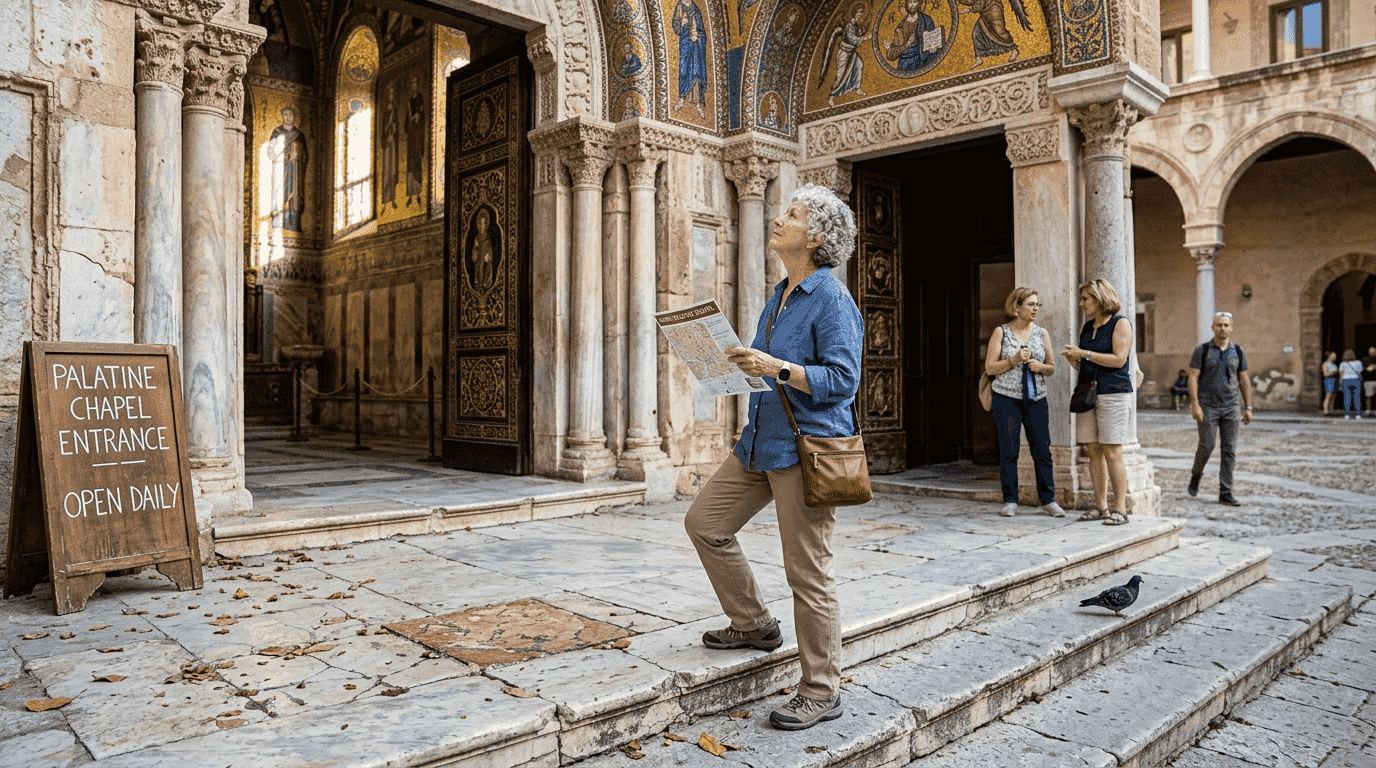
Roger II, crowned King of Sicily in 1130, exemplified this inclusive approach. His court employed Arab administrators, Greek scribes, and Latin clergy. Official documents appeared in Arabic, Greek, and Latin. The royal palace featured Islamic decorative programs alongside Christian chapels. This multicultural administration maximized human capital regardless of religious or ethnic background.
The Arab-Norman architectural style represents this era’s defining achievement:
- Palatine Chapel combining Byzantine mosaics, Islamic muqarnas ceilings, and Norman structure
- Church of San Giovanni degli Eremiti with distinctive red domes recalling mosque architecture
- Zisa Palace featuring Islamic pleasure garden layout and Arabic inscriptions
- Cathedral of Monreale blending Latin basilica plan with Byzantine iconography
These buildings employed craftsmen from multiple traditions working collaboratively. Muslim artisans created geometric patterns and calligraphy. Byzantine mosaicists produced religious imagery. Norman masons constructed pointed arches and vaulted ceilings. The resulting synthesis achieved aesthetic and technical innovations impossible within single cultural traditions.
| Element | Arab Contribution | Norman Addition | Byzantine Influence |
|---|---|---|---|
| Architecture | Pointed arches, gardens | Stone vaulting, towers | Domed structures |
| Decoration | Geometric patterns, calligraphy | Figural sculpture | Gold mosaics |
| Urban planning | Courtyard houses, markets | Fortifications, palaces | Churches, monasteries |
| Administration | Bureaucratic systems | Feudal hierarchy | Imperial protocols |
Norman kings practiced religious tolerance that shocked contemporary European rulers. Muslims served in the royal guard. Jewish scholars translated Arabic and Greek texts into Latin. Christian, Muslim, and Jewish festivals received royal patronage. This pragmatic pluralism strengthened royal authority while fostering economic prosperity.
Visiting Palermo’s Arab-Norman monuments today reveals how this cultural fusion created UNESCO World Heritage landmarks that transcend single traditions.
Medieval political turmoil and the Sicilian Vespers
The death of Frederick II in 1250 destabilized Norman Sicily, initiating decades of succession disputes. French Angevin rulers gained control in 1266, imposing taxation and administration that alienated Sicilian nobility and populace. Growing resentment against foreign occupation set conditions for violent uprising.
The Sicilian Vespers erupted on Easter Monday 1282 when Palermo residents massacred French soldiers following an incident at evening prayers. The rebellion spread across Sicily within days, expelling Angevin forces and inviting Aragonese intervention. This uprising transformed Mediterranean politics:
- Ended French Angevin rule over Sicily
- Established Aragonese dynasty controlling the island
- Sparked prolonged conflicts between France and Aragon
- Shifted power balances affecting papal and imperial politics
The Vespers demonstrated how local grievances could trigger geopolitical realignments. Sicilian resentment of French taxation and cultural imposition found expression in coordinated violence targeting occupying forces. The uprising succeeded partly because it united diverse Sicilian factions against a common enemy.
Aragonese rule following the Vespers brought Sicily into Spanish political orbit. Palermo became an administrative center for western Mediterranean possessions rather than an independent capital. This subordinate status persisted through centuries of Spanish and later Bourbon governance, limiting Palermo’s political autonomy while maintaining its commercial importance.
The rebellion’s legacy shaped Sicilian identity and politics into modern times. The Vespers represented resistance to foreign domination, a theme recurring in later independence movements. Understanding this medieval uprising clarifies patterns visible in Sicily’s subsequent history.
Exploring authentic Sicilian towns reveals how regional identities formed partly through resistance to centralized foreign control initiated during this turbulent era.
Modern history: unification to World War II
Giuseppe Garibaldi’s Expedition of the Thousand reached Sicily in May 1860, beginning the military campaign that unified Italy. Garibaldi captured Palermo after fierce street fighting, defeating Bourbon forces that had ruled Sicily for over a century. This victory proved decisive in creating the Kingdom of Italy proclaimed in 1861.
Unification brought contradictory results for Palermo and Sicily:
- Political integration into the Italian nation state
- Economic marginalization as southern regions received less investment than northern Italy
- Social disruption as traditional power structures collapsed
- Rise of the Mafia as parallel authority filling governance gaps
The Mafia emerged partly from conditions created by rapid political change without corresponding economic development. Rural poverty drove migration to cities including Palermo. Weak state institutions allowed criminal organizations to provide protection, employment, and social services. This criminal network became deeply embedded in Sicilian society over subsequent decades.
Pro Tip: When reading Sicily travel tips for 2026, understand that historical Mafia activity should not deter modern visitors from experiencing Palermo’s rich culture and improved safety.
World War II brought devastating destruction to Palermo. Allied bombing in 1943 severely damaged the city during the Sicily invasion that preceded the Italian mainland campaign. Historic buildings, infrastructure, and residential neighborhoods suffered extensive destruction. The port, railways, and industrial facilities became primary targets.
Post-war reconstruction modernized Palermo but often sacrificed historic preservation. Rapid development filled bomb sites with utilitarian buildings lacking architectural distinction. Some damaged monuments underwent restoration while others remained ruined for decades. This rebuilding period created the mixed urban fabric visible today, where medieval churches stand beside concrete apartment blocks.
The modern era tested Palermo’s resilience through war, organized crime, and economic challenges. Yet the city preserved core cultural identity rooted in its layered Mediterranean heritage. Understanding these recent struggles contextualizes contemporary Palermo as a city balancing historical legacy with modern development.
Architectural legacy and cultural impact
Palermo’s physical landscape embodies its complex history through architectural layers revealing successive cultural influences. Arab-Norman monuments recognized by UNESCO represent the most visible heritage, but Roman foundations, Byzantine churches, Spanish baroque palaces, and Art Nouveau villas contribute to the urban palimpsest.
The architectural legacy serves multiple functions:
- Tourism attraction drawing visitors interested in cultural heritage
- Symbol of Sicilian regional identity distinct from mainland Italy
- Educational resource teaching Mediterranean history
- Living environment shaping contemporary urban life
UNESCO World Heritage designation in 2015 recognized nine Arab-Norman monuments including the Palatine Chapel, Cathedral of Monreale, and Zisa Palace. This international recognition validated Palermo’s unique cultural synthesis and increased preservation funding. Heritage conservation now balances tourist development with maintaining authentic historical character.
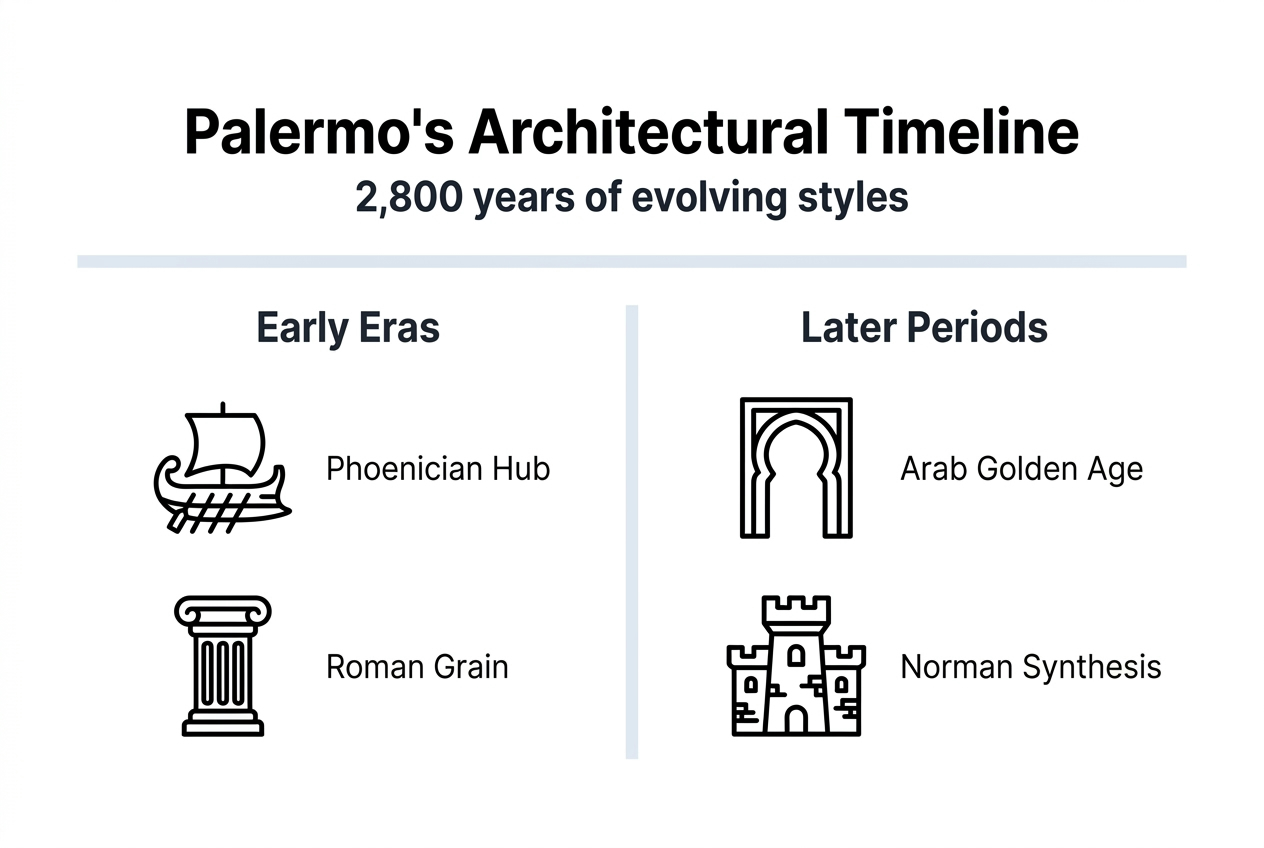
| Monument | Primary Era | Cultural Fusion |
|---|---|---|
| Palatine Chapel | Norman 1130s | Byzantine mosaics, Islamic ceiling, Latin structure |
| Cathedral | Norman 1180s | Gothic additions, baroque dome, Norman apses |
| San Giovanni Eremiti | Norman 1140s | Islamic red domes, Christian plan |
| Zisa Palace | Norman 1160s | Islamic garden design, Arabic inscriptions |
| Cuba Palace | Norman 1180s | Islamic pleasure pavilion adapted for Christian court |
This architectural diversity reflects broader cultural patterns. Palermo’s identity emerged from synthesis rather than single traditions dominating. Each ruling power adapted rather than erased predecessors’ contributions. This cumulative approach created complexity that distinguishes Palermo from cities developed within single cultural frameworks.
Modern Sicilian culture preserves elements from these layered influences. Cuisine combines Arab spices with Norman ingredients. Language includes Arabic loanwords. Religious festivals blend Catholic theology with local traditions. Architecture continues experimenting with historical revival styles.
Visiting Palermo’s cultural heritage sites reveals how history shapes present identity through monuments, neighborhoods, and traditions that connect contemporary life with Mediterranean civilizations spanning millennia.
Explore Palermo’s history with expert travel insights
Palermo’s layered past enriches every visit when you understand the cultural forces shaping its monuments, neighborhoods, and traditions. Sicilian Traveler provides detailed resources helping history enthusiasts and travelers maximize their Sicilian experience through expert guidance.
Plan your journey using guides to authentic Sicily tours that connect historical knowledge with on-the-ground exploration. Our essential Sicily travel tips prepare first-time visitors with practical advice for navigating Palermo and beyond. Discover why Palermo’s cultural landmarks attract discerning travelers seeking meaningful engagement with Mediterranean heritage rather than superficial sightseeing.
FAQ
What is the oldest known settlement in Palermo?
Upper Paleolithic cave art at Addaura on Monte Pellegrino provides the earliest evidence of human activity near Palermo, dating thousands of years before urban settlement. The Phoenician foundation around 734 BCE established the first permanent city named Ziz. This merchant colony initiated continuous urban occupation spanning over 2,800 years.
How did Arab rule transform Palermo?
Arab governance beginning 831 CE transformed Palermo into one of Europe’s largest and wealthiest cities with over 300,000 inhabitants. Advanced irrigation, new agricultural crops, and sophisticated urban planning created economic prosperity. The multicultural environment fostered intellectual achievement and architectural innovation that defined Palermo’s golden age.
What was the impact of the Sicilian Vespers uprising?
The 1282 Sicilian Vespers expelled French Angevin rulers and brought Aragonese control over Sicily. This violent uprising shifted Mediterranean power balances, sparking prolonged conflicts between France and Aragon. The rebellion demonstrated how local resistance could trigger geopolitical realignments affecting papal and imperial politics across Europe.
How does Palermo’s architecture reflect its history?
Arab-Norman buildings symbolize cultural fusion blending Islamic geometric decoration, Byzantine mosaics, and Norman structural innovation. UNESCO World Heritage recognition validates this unique synthesis preserved in monuments like the Palatine Chapel. Successive eras added Roman, Spanish, and modern layers creating an architectural palimpsest revealing Mediterranean civilizations across millennia.